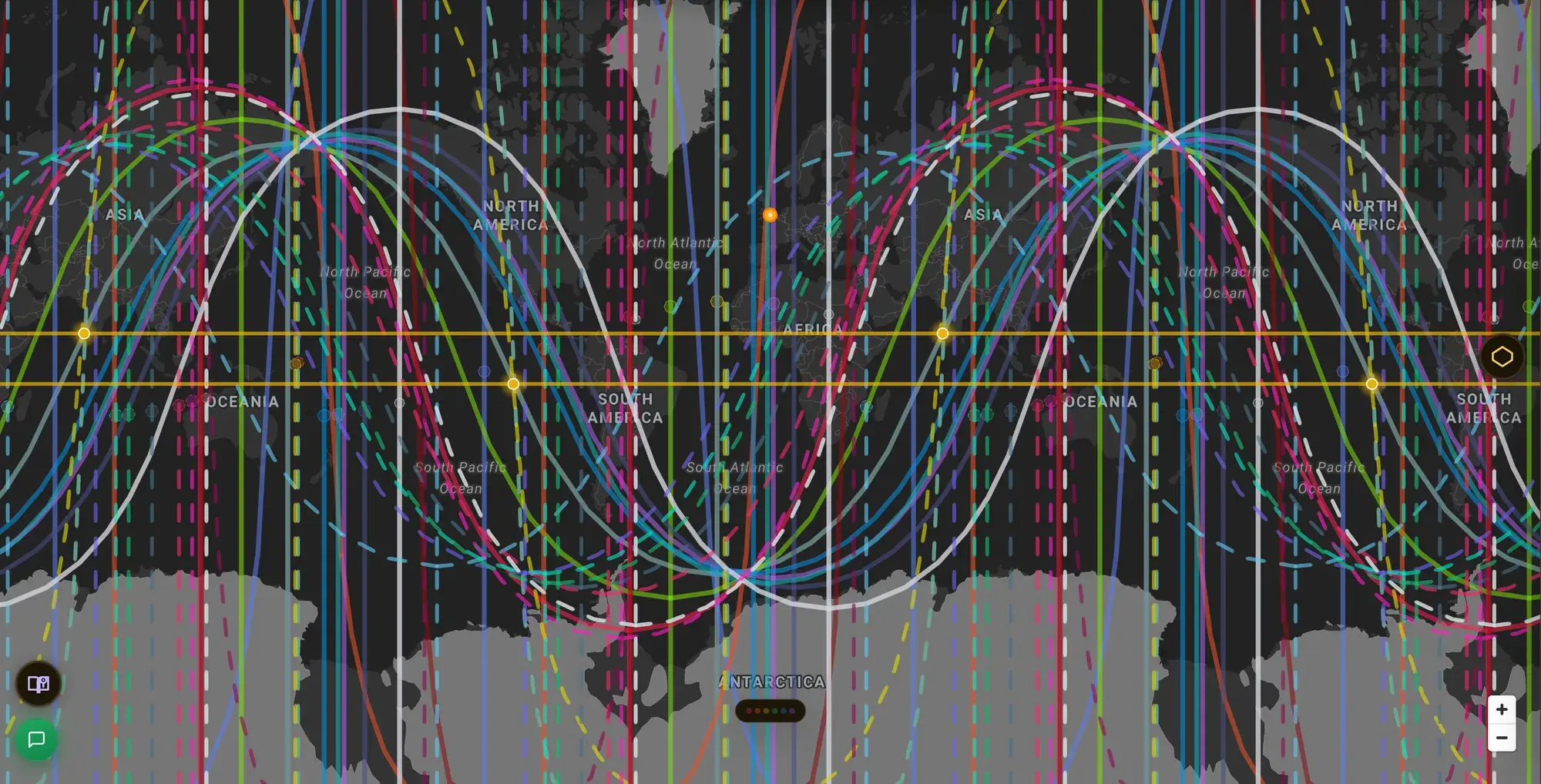
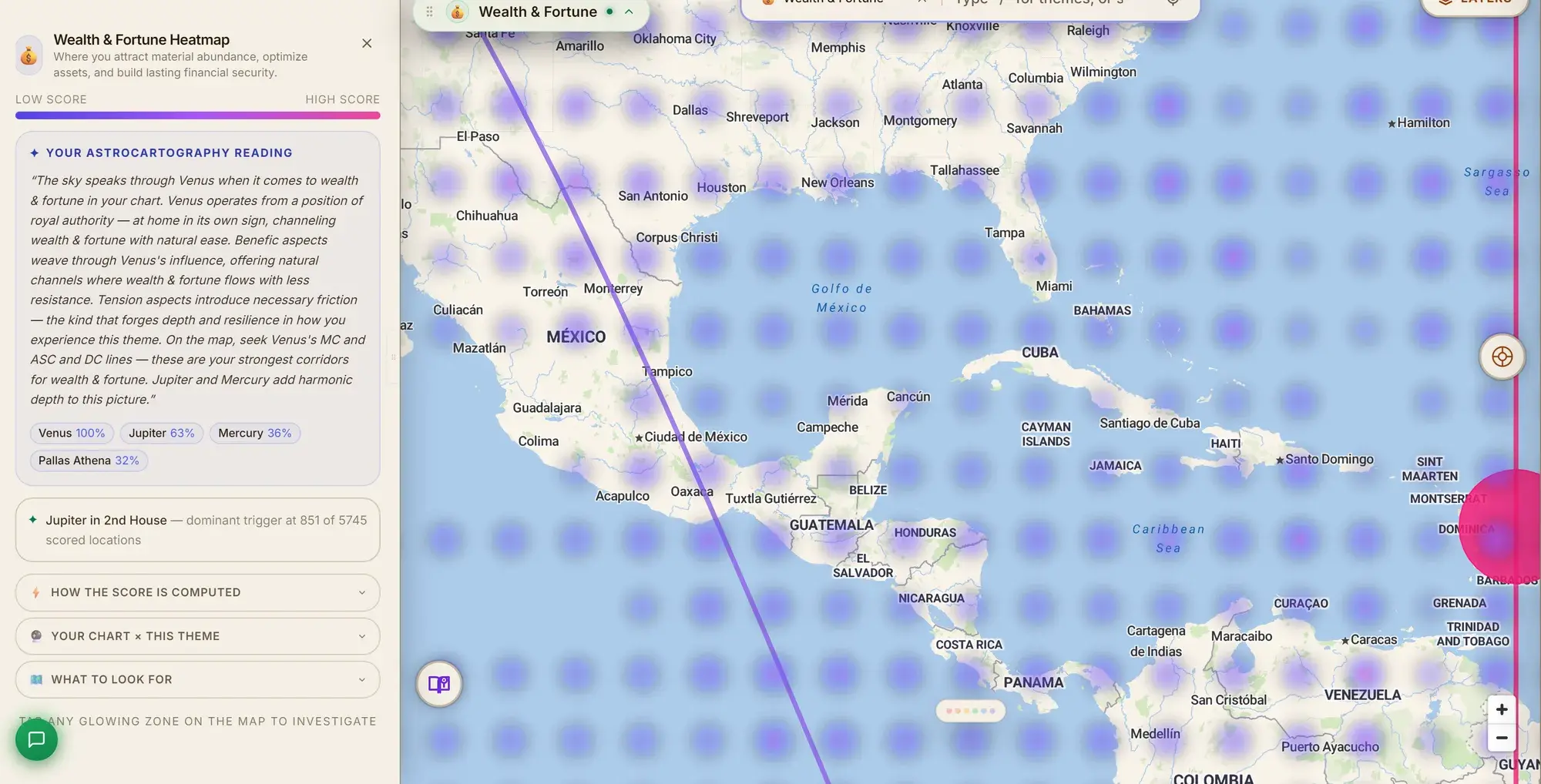
Family Relocation Astrology
Family relocation astrology reads one place against every chart in the household: partners, children, and composites. You can weigh a move for everyone.

Photo: George Swanepoel / Unsplash
Family relocation astrology reads one place against more than one birth chart at once: yours, a partner's, a child's. The same city can be a career line for one parent and a hard line for a kid. This is astrocartography for the whole household. You see both sides before you sign a lease, not after. ELA Map can overlay up to five charts on a single map, color-coded, and cast a true composite for the relationship between them.
Almost every relocation tool answers the question for one person. But almost nobody moves alone. The hard version of "where should we live" is the one that keeps people up at night. It's the household version, and a single-chart map can't touch it. That's the version this page is about.
Every chart in the house moves with you
When you relocate, you don't relocate one chart. You relocate everyone's chart, all to the same address, all at once. Each person was born at a different moment, so the lines that cross a given city are different for each of them. One place is really several relocations stacked on top of each other.
That explains a pattern every couple eventually notices: a town one partner finds electric, the other finds exhausting. Or a move that's perfect for the adults and quietly wrong for a seven-year-old. The location never changed. The chart it was read against did. Family astrocartography puts those readings next to each other, instead of letting you discover them one unpacked box at a time.
What you're actually looking for
Lay several charts over the same place and a few things matter more than the rest:
- Where lines stack up. Places where more than one person has a supportive or angular line nearby are the real family candidates. The location lifts two of you at once, not just whoever booked the trip.
- The split places. Strong for one chart, rough for another. Most real cities are split. The work isn't avoiding that. It's deciding whose lines lead this chapter: a kid who needs to feel rooted, a parent making a career bet, a grandparent who needs ease.
- Whose angle is lit. A career (overhead) line for an adult sharing a city with a home (underfoot) line for a child is usually a better arrangement than two adults both chasing overhead lines in the same place.
- The quiet members. A place with no strong lines for someone isn't a bad place for them. It's neutral. And neutral is exactly right for the person who just needs somewhere that leaves them be.
Nobody finds the city that's perfect for everyone. It mostly doesn't exist. What you can find is a city whose trade-offs you chose on purpose.
Put your household on one map
Free, no card. Start with your own chart, add the family when you're ready.
Get startedBuilt from the start for the household question
Reading one chart over a map is common. Reading several against the same place, and the relationships between them, is the part almost nothing was designed to do. That's why almost nothing does it well. A single-chart viewer with a second chart bolted on tells you about two individuals. It doesn't tell you about a household.
ELA Map was written from the start for the multi-person version of the question, and it gives you three ways to ask it.
Put everyone on one map. Overlay several charts on the same globe, as many as five at once, color-coded so you can tell at a glance whose line is whose. A family stops being a stack of separate readings you hold in your head and becomes one picture. The coastline that's a soft Venus line for one partner and a hard Saturn line for the other becomes something you can see, side by side, instead of something you find out the hard way after the move.
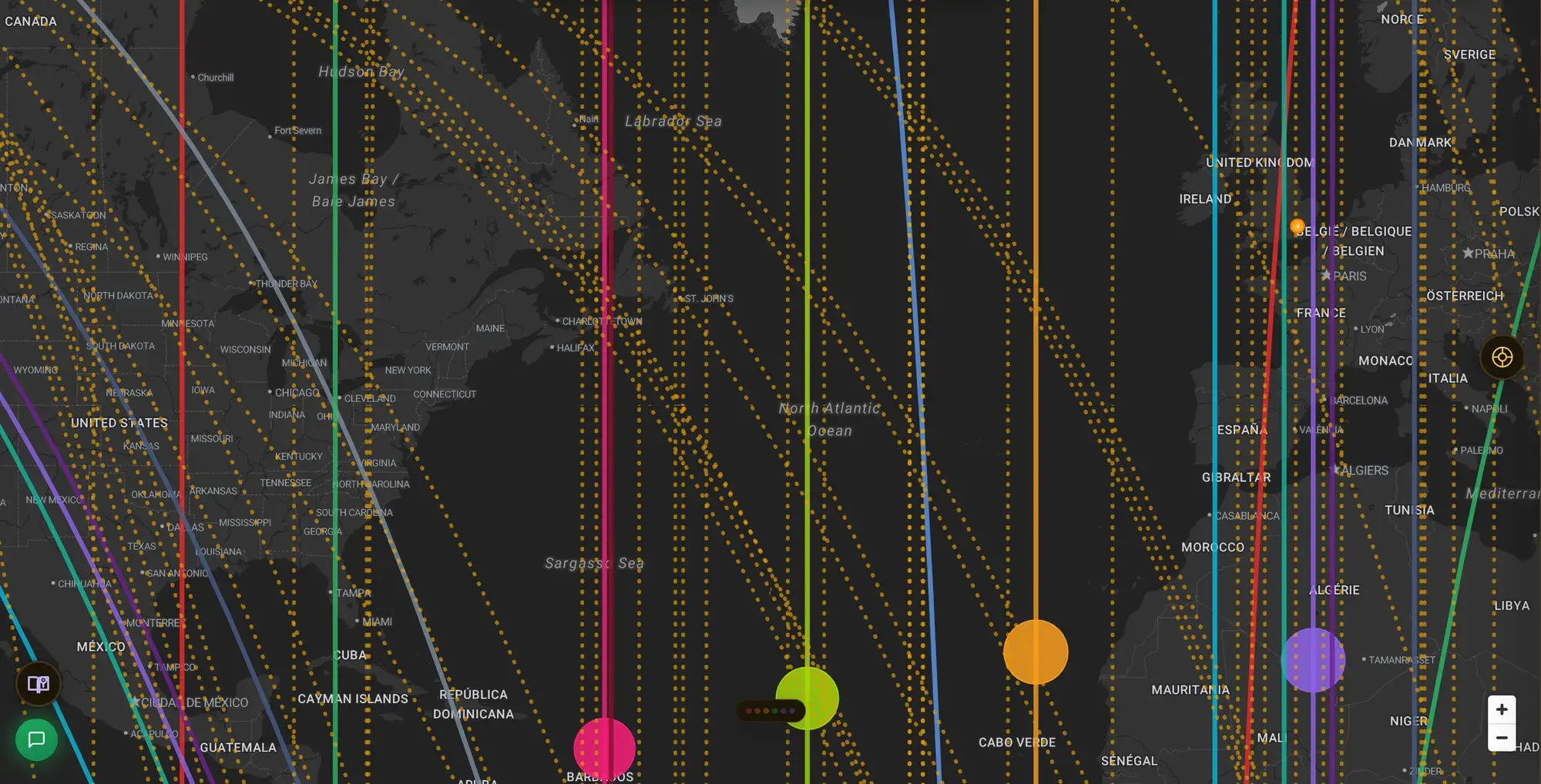
Two charts on one map: a London-born partner and a New York-born partner, color-coded, read against the same stretch of coastline. Where one person's line meets the other's is the charged place a single-chart map can never show you.
Find where two people cross. Individual lines are only the start. The charged places are where two people's lines meet. A crossing between your line and a partner's is often the single most telling point on the map. It's a spot where two geographies land in the same room, which reads as magnetism or as friction depending on what's meeting there. (Astrologers will recognize the deeper form of this: parans, where two bodies reach the angles together at the same latitude.)
Read the relationship itself. Two people sharing an address is not the same as the bond between them. A Davison composite chart treats the relationship as its own entity. It's cast for the actual midpoint moment and place of the partnership, not a mathematical average, and ELA Map maps that across the Earth exactly the way it maps a person. For couples especially, the composite line over a city is often a more honest reading than either chart alone. That's because the thing you're really relocating is the us, not two separate people who happen to share a kitchen.
None of these is a single-chart viewer with a second chart bolted on. They're why the hard, high-stakes, more-than-one-person version of "where should we live" actually has somewhere to go.
Reading children, gently
For a child, lead with the stable-and-supportive reading, not the ambitious one. The question for a kid is almost never "does this place advance a career." It's "does this place let them feel at home and grow into themselves." When a city splits between a parent's opportunity line and a child's hard line, that's not automatically a no. But it is a real cost. Name it out loud and weigh it, don't discover it later.
Using it in ELA Map
- Reading the Map: the grammar of lines and angles you'll apply to every chart in the family.
- Relocation Analysis: what shifts in a single chart when you move, before you stack the rest of the household on top.
- Synastry & Composite: reading the relationship between two charts, which the composite map extends across geography.
- Human Design Astrocartography: if your family also works with Human Design, the same place can be read for each person's design.
- Best Places to Live: how to weigh candidate places honestly before you stack the household's charts on them.
- The Astrocartography Heatmap: scoring whole regions at once, per chart, instead of reading line by line.
- Glossary: plain-language definitions for composite, synastry, crossing, and the rest.
How the charts are computed
Every line for every person is projected from the same NASA/JPL planetary data used to navigate spacecraft, through an ephemeris engine ELA Map built specifically for full-globe work. Every interpretation traces back to named, written astrological doctrine that reads the same way every time. A family map isn't a machine guessing what you want to hear. It's several accurate maps held honestly against one place. (For the engineering behind that, see the data and engine behind ELA Map.)
Score a move against home
Free. No card. Compare a place you're considering to where you live now: your chart, about two minutes.
Get started