Best Places to Live by Human Design and Astrocartography
There is no single 'best' place to live. Astrocartography and Human Design can show you what a place amplifies in you, so you can feel more empowered wherever you are.

Photo: Sylvain Mauroux / Unsplash
There is no single best place to live. Any tool that promises you one is selling escape, not insight. Astrocartography and Human Design can show you what a place amplifies in you: which corridors run warm and which run demanding. But "best" depends entirely on what you're actually after this season of your life. This guide isn't a map of where to flee to. It's a way to choose the ground under your feet on purpose, home included.
There is no single best place
The most useful version of "where should I live" isn't "where do I flee to." It's "what is already alive in the ground beneath me, and what would a different ground ask of me instead?" That reframe matters, because the whole internet is happy to sell you the other version: a green dot on a map, a promise that the life you want is a plane ticket away.
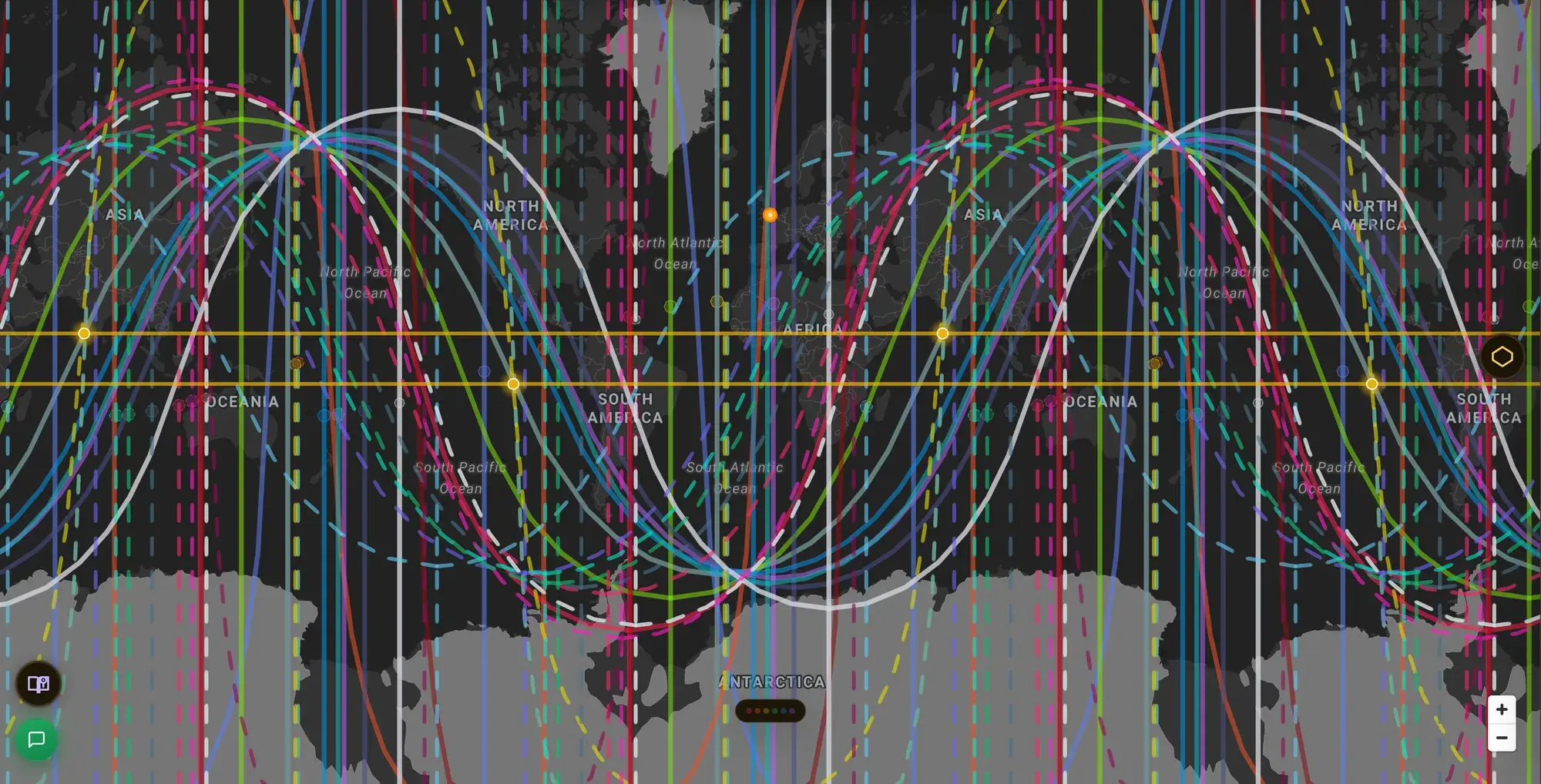
Here is the mechanic underneath the honesty. Your Human Design doesn't move when you relocate. Type, Strategy, Authority, and Profile are calculated once, from your birth data, and they are fixed for life. A Projector doesn't become a Generator by crossing a border. What changes by location is expression: how loudly your already-defined gates and channels get played, and how much conditioning pressure your open centers pick up from the place and the people in it. Astrocartography draws the same story in planetary terms: the lines where each planet in your chart runs hottest across the Earth. Neither one hands you a verdict. Both of them describe terrain.
And no terrain is disqualifying. The old cookbook sorts astrocartography lines into easy and hard: Venus and Jupiter the happy ones, Saturn and Pluto the difficult ones. A line is not a sentence. A Saturn line can be exactly the structure a scattered season needs, the wall that finally gives your days a shape. A Pluto line can be where an overdue transformation finally has room to happen. It's uncomfortable and necessary in equal measure. Every place is powerful. The question is never "is this a good line." It's "is this what I want more of, right now."
How to actually weigh a place
If you're genuinely deciding, the map gives you two honest lenses on a place before you ever book a flight. It also gives you one check that doesn't happen in the head at all.
Lens one, the astrocartography lines. Look at which of your planetary lines pass through or near the place, and on which of the four angles each one hits. The angle changes the meaning as much as the planet does.
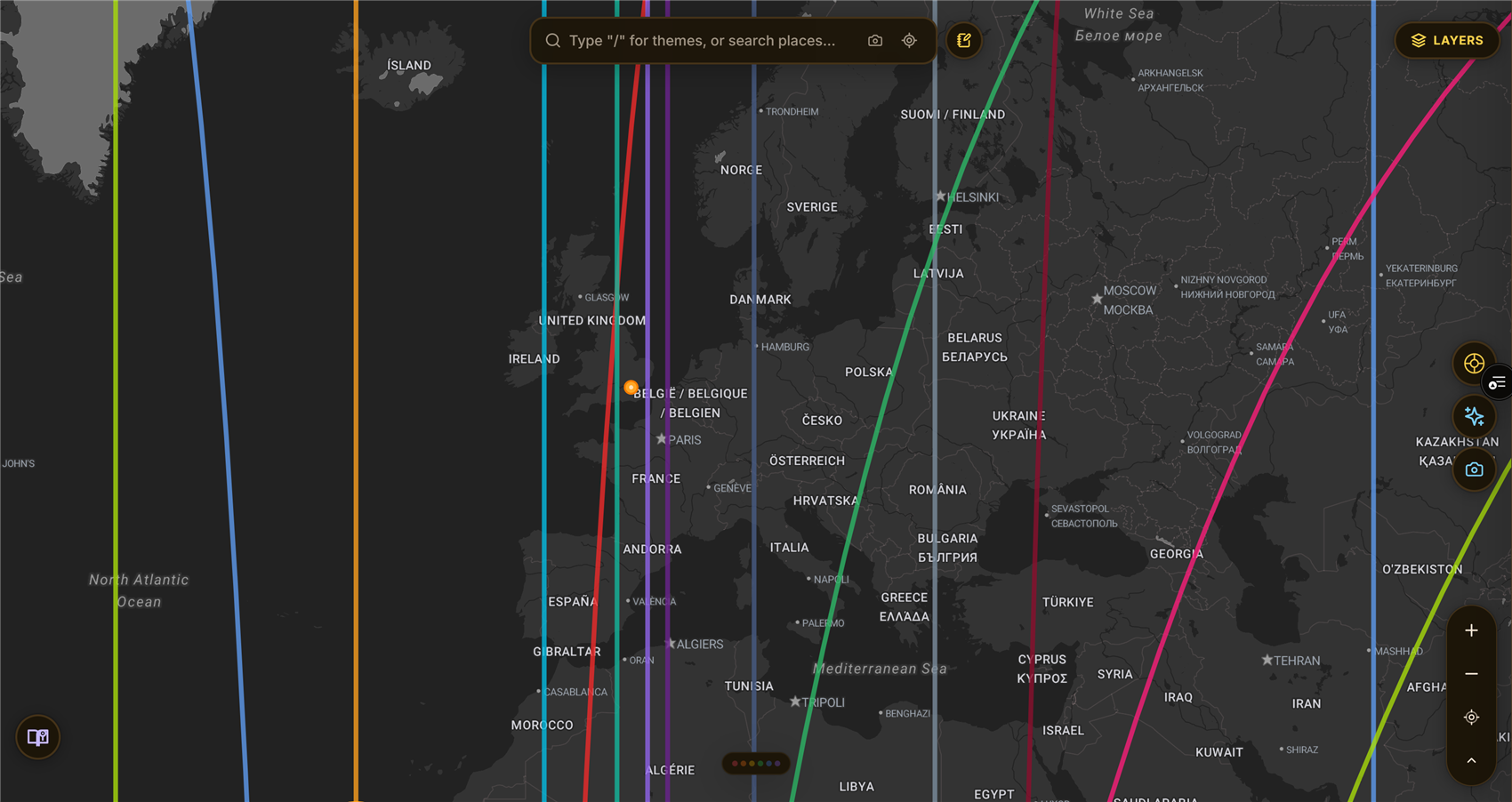
Zoomed into a region, several candidate cities at once: which lines actually pass near each one, at a scale you can compare.
| Angle | Line | What that place tends to pull out of you |
|---|---|---|
| Rising | AC | Leads. The first quality a place draws out, how you show up there. |
| Setting | DC | Arrives through other people: relationship, partnership, who you meet. |
| Overhead | MC | Goes public: vocation, reputation, the version of you the world sees. |
| Underfoot | IC | Works in private: home, family, your inner ground and rest. |
Lens two, the Human Design layer. Check which of your defined gates and channels get amplified there. Just as important, check which of your open centers will pick up more conditioning. Take an open Solar Plexus in an emotionally loud city, or an open Root somewhere relentlessly fast. The place isn't defining anything new in you, but it can turn up the volume on the pressure your openings already feel. Knowing that in advance is the difference between "why do I feel so wired here" and "ah, this is my open Root reading the room."
The third check is somatic. In Human Design, it's the one that actually decides. Your Authority is a body-based signal, not a mental verdict. So after you've read the two lenses, sit with each option. Notice the response your design is built to trust: the sacral uh-huh or uh-uh if you're a Generator, the emotional wave over a day or two if you're an emotional Authority, the settled or unsettled gut of a splenic knowing. Look at a photo of the place, say its name out loud, imagine a morning there, and feel what your body does. The map narrows the field to a few honest candidates. The choice between them was never meant to be argued out in the head.
See what your candidates amplify
Free, no card. Your two lenses on any place, in about two minutes.
Get started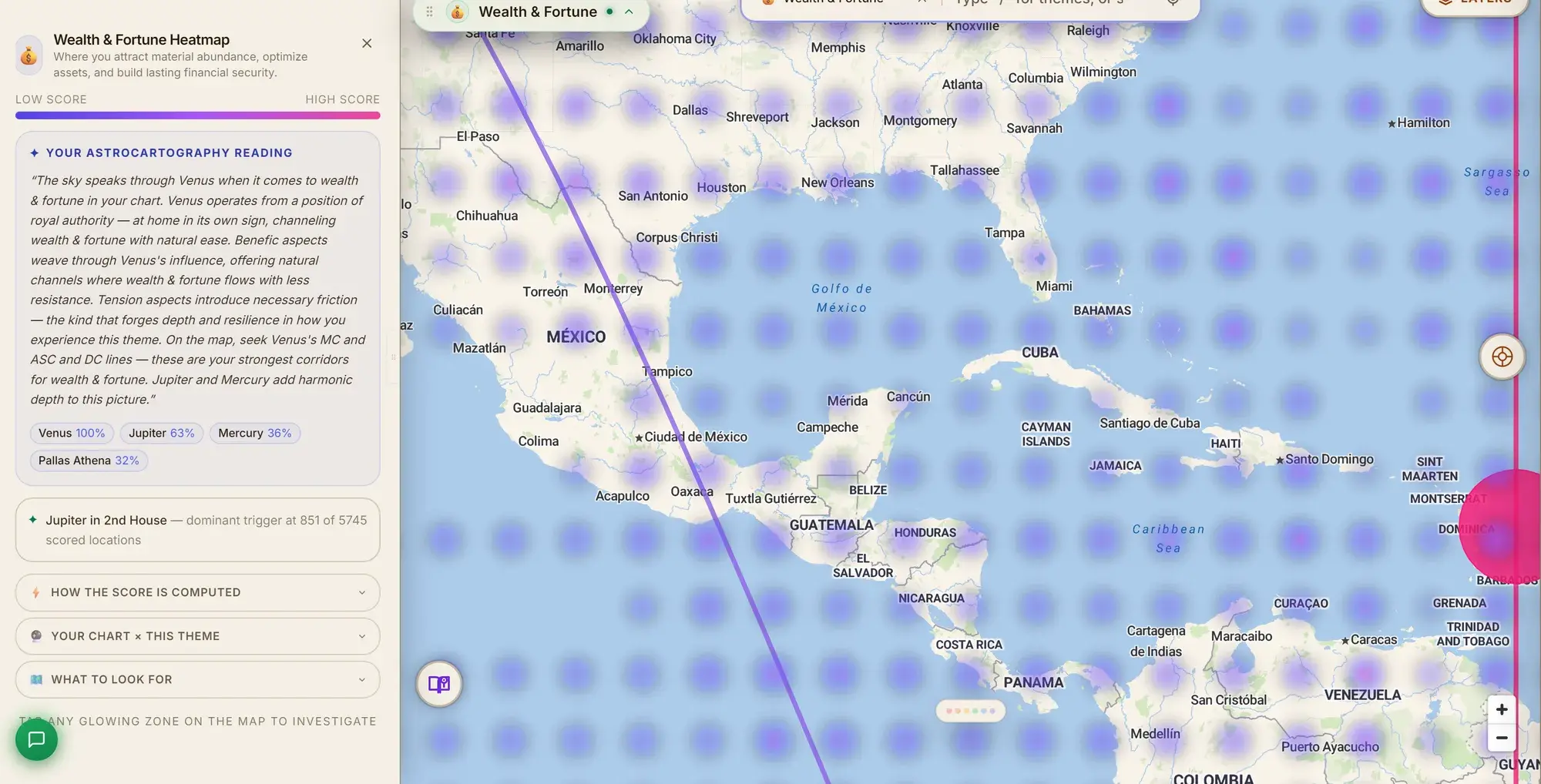
Comparing places in ELA Map: the heatmap scores a whole region at once and names the planets driving each zone. Weighing several candidate cities becomes one readable map instead of forty lines to eyeball.
What the map can decide, and what it can't
A line tells you what a place tends to amplify. That's the whole of what it knows. What to do with a loud place, whether it's one to lean into for a season or to visit lightly and leave, is a human judgment. You make a better one when you weigh your whole life: the people, the work, the money, the body, the timing. Hold the reading against your Strategy and Authority and let it inform the decision, not replace it.
It also isn't a reason to leave. Astrocartography is as much a map of the place you already live as of anywhere else. Often the most useful thing it does is explain why here has felt the way it has. Read as sojourning, a way to travel with your eyes open and choose a season somewhere deliberately, it's a gift. Read as "the life I want is somewhere I'm not," it quietly becomes a machine for dissatisfaction.
Where should I live? The astrology answer
"Where should I live" is the question people bring to astrocartography first, and it's usually the wrong shape. Underneath it is almost always a quieter one: am I allowed to feel this unsettled where I am? Would somewhere else fix it? A map can't answer that, and it shouldn't pretend to. What it can do is show you, honestly, what each place tends to pull out of you. So whether you stay or go, you're choosing on purpose instead of running.
Every place is powerful. Even the demanding lines have their reasons, and the calm ones aren't automatically where you'll grow. Use the map to understand the ground you're standing on, and to walk onto new ground with your eyes open. That's the whole of what it's for, and it's plenty.
Reading it in ELA Map
- Astrocartography: The Complete Beginner's Guide: where the lines come from and the four angles, if locational astrology is new to you.
- Human Design Astrocartography: the astrocartography of your bodygraph, the defined-vs-open distinction this guide leans on.
- The Astrocartography Heatmap: scoring a whole region at once so you can compare many places instead of reading one line at a time.
- Family Relocation Astrology: reading one place against more than one chart, for a move that isn't just yours.
- Astrocartography Lines Meaning: what every planet's line means on each angle, when you want to read a specific corridor in detail.
- Glossary: plain-language definitions for lines, angles, gates, centers, and every other term this guide uses.
- A sample Location Context Report: a full written reading of one place for one chart, so you can see what "reading a city properly" looks like before you order one.
Score a city you're considering
Free. No card. Weigh anywhere you're eyeing against home: your chart, about two minutes.
Get started