Astrocartography: The Complete Beginner's Guide
Astrocartography draws your birth chart across a map of the Earth: every planet becomes a line. A guide to the four angles and how to read your own map, free.

Photo: Greg Rakozy / Unsplash
Astrocartography draws your birth chart across a map of the Earth. Every planet in the sky the moment you were born traces a line. Where that line falls is where that planet runs strongest for you. A birth chart alone can't tell you this: not just what your chart is, but where on Earth each part of it gets loud. Read well, it's less a map of where to escape to than a map of what is already alive in the ground beneath you.
The sky you were born under was never fixed to one dot on the map. The same planets that shaped your chart reach every corner of the Earth. They trace lines through places you've lived, places you've loved, and places you have never once thought about. No line is a verdict. Even the ones with fearsome reputations, like a Saturn line or a Pluto line, are sometimes exactly the terrain a chart needs. This guide covers where the lines come from, what the four angles mean, how to read your own map, and the one habit that separates a useful reading from a superstitious one.
Where the lines come from
At the moment you were born, every planet sat at a specific point in the sky. Astrocartography takes those positions and asks a geographic question of each one: across the whole surface of the Earth, where is this planet rising, setting, directly overhead, or directly underfoot right now? The answer for a single planet is a line, or a pair of lines, drawn across the globe. Do it for every planet and you get the streaked, colorful map most people picture when they hear the word.
The vertical lines are meridians. That's where a planet is culminating overhead or sitting at the lowest point beneath you. The curved lines are horizon lines, where a planet is rising or setting. They bend because the geometry of the horizon changes with latitude. None of this is metaphor. It's the same spherical astronomy that tells a sailor when a star will clear the horizon, applied to the planets in your chart instead of navigation stars.
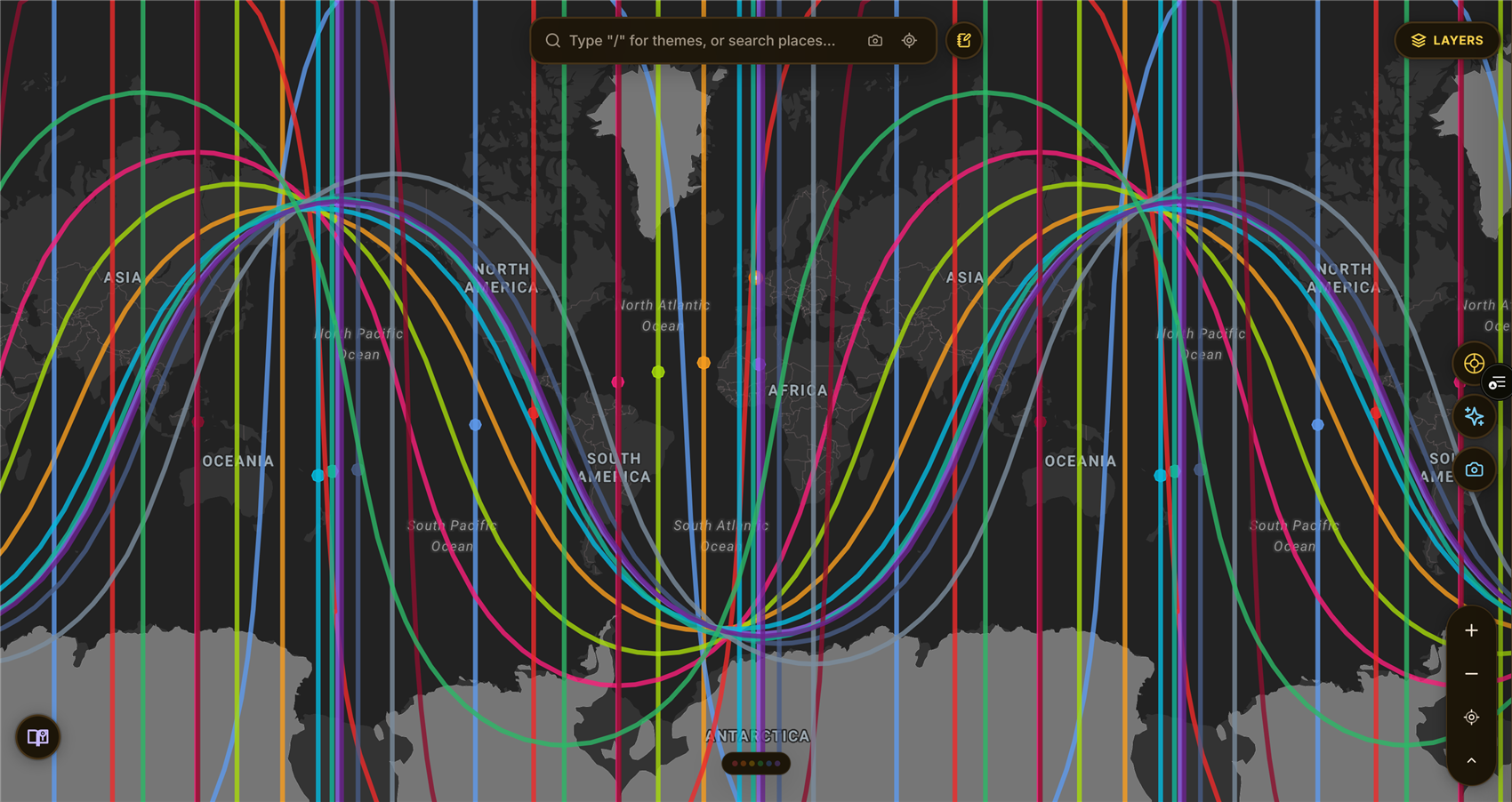
Astrocartography in ELA Map: every planet from one birth chart, drawn as its own set of lines across the entire Earth. Vertical lines are meridians (overhead and underfoot). Curved lines are horizons (rising and setting).
The four angles: rising, setting, overhead, underfoot
A line is only half the information. The other half is which of the four angles the planet is hitting there. The same planet feels different depending on how it meets the horizon. These four angles are the basic vocabulary of the whole technique.
| Angle | Line | What it does |
|---|---|---|
| Rising (Ascendant) | AC | The planet leads. It's the first thing a place pulls out of you, the quality you show up wearing. |
| Setting (Descendant) | DC | The planet arrives through other people: partnership, relationship, who you meet there. |
| Overhead (Midheaven) | MC | The planet goes public: vocation, reputation, the version of you the world sees. |
| Underfoot (Imum Coeli) | IC | The planet works in private, at the root: home, family, your inner ground. |
So Venus rising is not the same as Venus overhead. One leads with warmth and ease in how you show up. The other puts beauty, relationship, or values at the center of your public life. Reading the angle, not just the planet, is the difference between a real reading and a horoscope-column guess.
No line is a verdict
Here is the single most important habit for reading a map honestly. It's also where most guides go wrong. The older, cookbook style of astrocartography sorts the lines into easy and hard: Venus and Jupiter are the happy blue lines, Mars and Pluto the difficult red ones. That shorthand isn't wrong so much as shallow. The psychological tradition of the technique rejects it. Jim Lewis, who coined the modern practice, and humanistic astrologers like Dane Rudhyar both treat a place as terrain, not a sentence handed down.
A Saturn line, the classic "hard" line, can be exactly the structure a scattered life needs. It's the wall that finally gives your work an edge and your days a shape. A Pluto line can be where a long-overdue transformation finally has room to happen: uncomfortable and necessary in equal measure. And a Jupiter line, the classic "lucky" one, can just as easily be where you overextend and lose the plot. What decides the experience is the fit between the line and your particular chart and season of life, not the color it's drawn in. ELA Map keeps the traditional character of each planet, and refuses to reduce any line to good or bad.
What astrocartography is for, and what it isn't
Astrocartography is at its best as a tool for understanding, not escape. It's as much a map of the place you already live as of anywhere else. Often the most useful thing it does is explain why here has felt the way it has. Read it as a way to see what's alive in a place, to travel with your eyes open, to choose a season somewhere on purpose. Read it as "the life I want is somewhere I'm not," and it quietly becomes a machine for dissatisfaction.
It also isn't a decision engine. A line tells you what a place tends to amplify. What to do with that, whether a loud place is one to lean into or to visit lightly, is a human judgment. It's a better one when you make it with your whole life in view, rather than handing it to a map.
The data underneath the map
A map is only as trustworthy as the lines on it. This is where most astrocartography online quietly falls short: it's vague about the one thing that matters, where the lines actually go. A line that lands on the wrong side of a coastline or a mountain range is worse than no line at all.
ELA Map computes every line from research-grade NASA/JPL planetary data, the same datasets used to navigate actual spacecraft. It runs them through an ephemeris engine built specifically for full-globe work. Every interpretation on the map is sourced from transparent, named astrological doctrine, not generated by an AI model guessing at plausible-sounding language. (Today readings and Location Reports are compiled from that same interpretation library, refined by AI.) You can always see which tradition produced the sentence in front of you, and disagree with it if you like. People have argued about astrology for as long as it has existed. An honest tool invites that argument rather than hiding behind confident prose.
Reading it in ELA Map
Astrocartography is the ground floor of everything ELA Map draws. Good places to go next:
- Astrocartography Lines Meaning: the detailed companion to this page, what every planet's line means on each of the four angles, when you're ready to go planet by planet.
- Reading the Map: the shared grammar of lines, angles, and orbs across every layer, if you want the hands-on how-to.
- Human Design Astrocartography: the same geometry read through Human Design's gates and channels instead of the planets.
- The Astrocartography Heatmap: scoring a whole region at once instead of reading one line at a time, for when you want to compare many places.
- Relocation & Family Moves: how the map changes when you're choosing a place for more than one person.
- The Data Engine: why full-globe accuracy needs a purpose-built ephemeris engine, not a single-chart astrology library.
- Glossary: plain-language definitions for every term on this page: angles, orbs, lines, and the rest.
See your own lines
Free. No card. Your birth chart drawn across the whole Earth in about two minutes.
Get started