The Data and Engine Behind ELA Map
ELA Map takes accuracy seriously. Every line runs on NASA/JPL's own DE440 planetary ephemeris. This is the same data used to navigate spacecraft.
Photo: Patrick Hendry / Unsplash
ELA Map runs on NASA/JPL's own DE440 planetary ephemeris. This is the same data used to navigate spacecraft. We wrapped it in an engine built specifically for mapping a chart across the whole Earth. Planetary positions agree with NASA's reference to within a tenth of an arc-second. The engine checks itself against NASA's live service every hour. The interpretations on top of that come from transparent, named astrological doctrine, not a language model improvising. (Today readings and Location Reports are compiled from that interpretation library, refined by AI.) That combination is what we mean by Personalized Geographic Intelligence.
There's a lot of astrology software on the internet. A fair amount of it is exactly what a skeptic assumes: a thin layer of generated text over numbers nobody checked. We built ELA Map for the opposite reason. We wanted a tool we'd trust with a real decision about where to live. That meant asking two questions almost nobody asks an astrology product: where do the numbers come from, and who is writing the words. This page answers both, honestly.
Where the numbers come from
Most astrology tools compute planetary positions from Swiss Ephemeris. It's a good library, but it's a compressed derivative of older NASA data from the 2000s. ELA Map doesn't use the derivative. It uses the source: JPL DE440, the Jet Propulsion Laboratory's development ephemeris, in the same binary kernel format NASA distributes for mission work. The positions that place Mars on your map come from the same dataset used to point antennas at real spacecraft.
That data covers the years 1550 to 2650 CE. This easily spans any birth chart and any relocation you'll ever run. It's not a model we trained or a table we typed. It's the authoritative planetary record, used directly.
We're a little stubborn about this part, because it's the foundation everything else stands on. If the positions are off, every line on the map is off with them. No amount of good interpretation can save a reading built on a wrong number.
Astronomy and astrology were never two trades
It's worth saying plainly, because the modern world often forgets it. For most of recorded history, astronomy and astrology were one discipline. The math was developed to serve the practice. The Babylonians kept the sky's records because the positions meant something to them. Ptolemy compiled the first great star catalog in the Almagest, as an astronomer, for astronomical needs. He then wrote the Tetrabiblos on what those positions signified. The same hand did both. Kepler refined planetary motion while casting charts for a living. The ephemeris tables that later made navigation and astronomy possible began as tools for knowing where the planets were, so a practitioner could read them.
That shared root matters for a specific reason: improving the astronomy has never broken the astrology. As one old commentary on Ptolemy put it, his astrology "is just as applicable to modern and improved astronomy as it was to his own." Better numbers don't dissolve the tradition. They sharpen it. A line drawn from a position good to a tenth of an arc-second lands on the correct side of a mountain range. A line drawn from a rough one doesn't. The interpretive craft is centuries old. What changed is that we can finally feed it positions worthy of it.
That's why ELA Map went to the cutting edge of computation instead of settling for "close enough." Our goal isn't to replace the tradition with technology. It's to give an old, careful practice the precise sky it always assumed it had, and to bring it to life on a map of the whole Earth. That's something the people who built the tradition could only have dreamed of.
Give your chart the precise sky
Free, no card. Your placements on NASA-grade data in about two minutes.
Get startedAn engine that checks itself against NASA, every hour
Using good data once is easy. Knowing your software is still producing it, after a library update, a server migration, or a subtle compilation change, is the part that usually gets skipped.
ELA Map's engine doesn't skip it. A background process acts like its immune system. Once an hour, it takes its own freshly computed planetary positions and compares them against NASA's live JPL Horizons service, the public, authoritative ephemeris NASA itself runs. If our numbers ever drift from NASA's by more than a tenth of an arc-second, the system flags it before it can reach a chart.
A tenth of an arc-second is roughly the width of a coin seen from forty miles away. We hold ourselves to that standard, continuously, against NASA's own answer. Very little astrology software ever re-checks its own accuracy after release. Ours checks every hour, and keeps the receipt.
Why we had to build our own engine
If the data is NASA's, what did we actually build? The engine that turns it into a map.
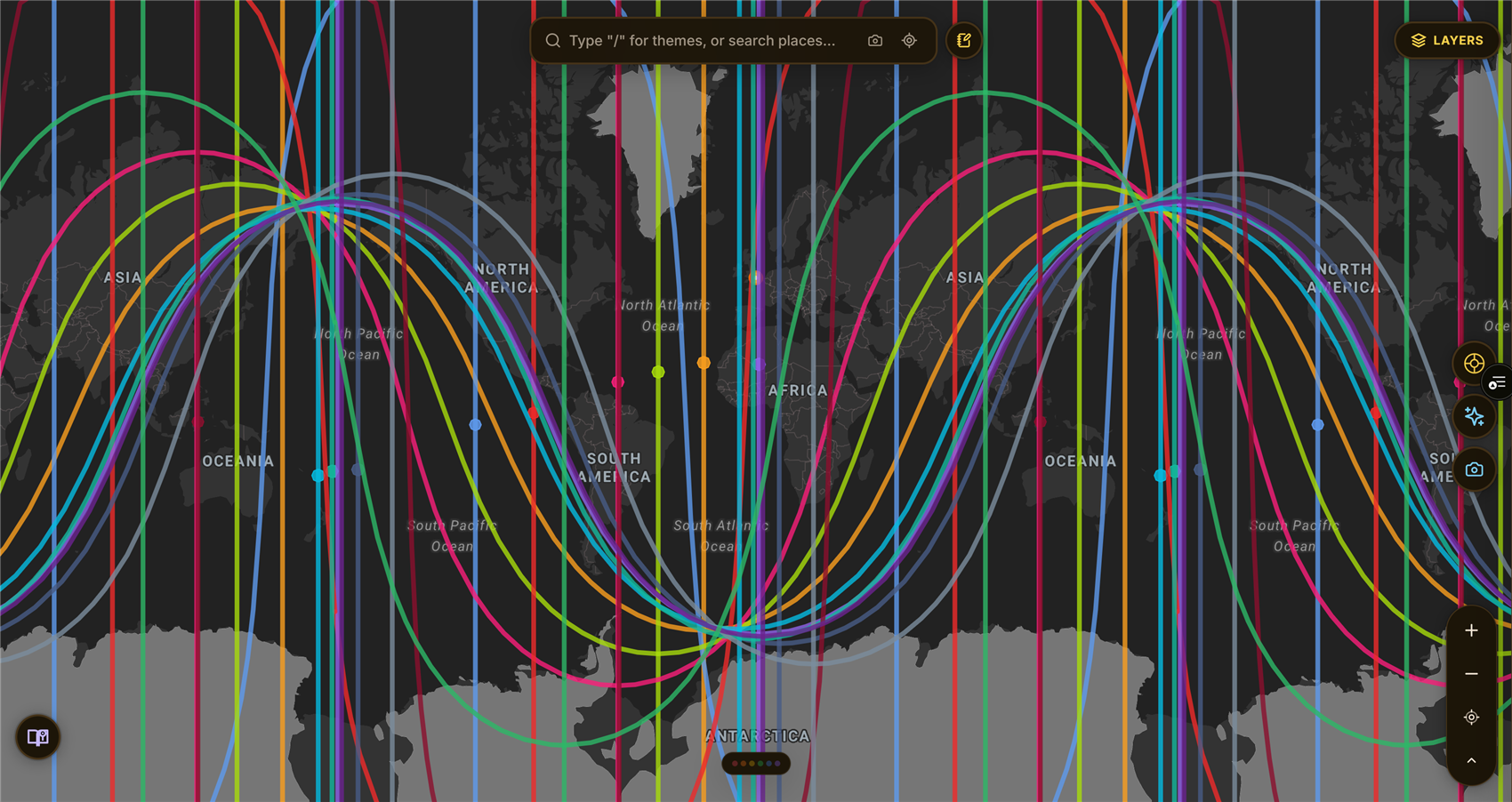
Casting a single birth chart is a solved problem. Fix a time and a place, compute a few angles, done. Casting your entire chart against every point on the surface of the Earth is a different kind of problem. Ordinary astrology libraries were never designed for it. They cast one chart at a time. We needed to compute, for every body, the lines where it was rising, setting, overhead, and underfoot, sweeping the whole globe. Then we needed the points where those lines cross, and the deeper crossings (the parans) where two bodies reach the angles together at the same latitude. That last calculation is solved numerically. It converges on each crossing to a precision far finer than any pixel could show.
Doing all of that across a planet's worth of coordinates, fast enough to feel instant, is the real work. It's also why ELA Map can do things that are genuinely hard to find elsewhere: full-globe relocation analysis, region-wide scoring, multi-chart overlays, and the relationship between two people read across the Earth. Those aren't features we bolted on. They come from having built the right engine underneath.
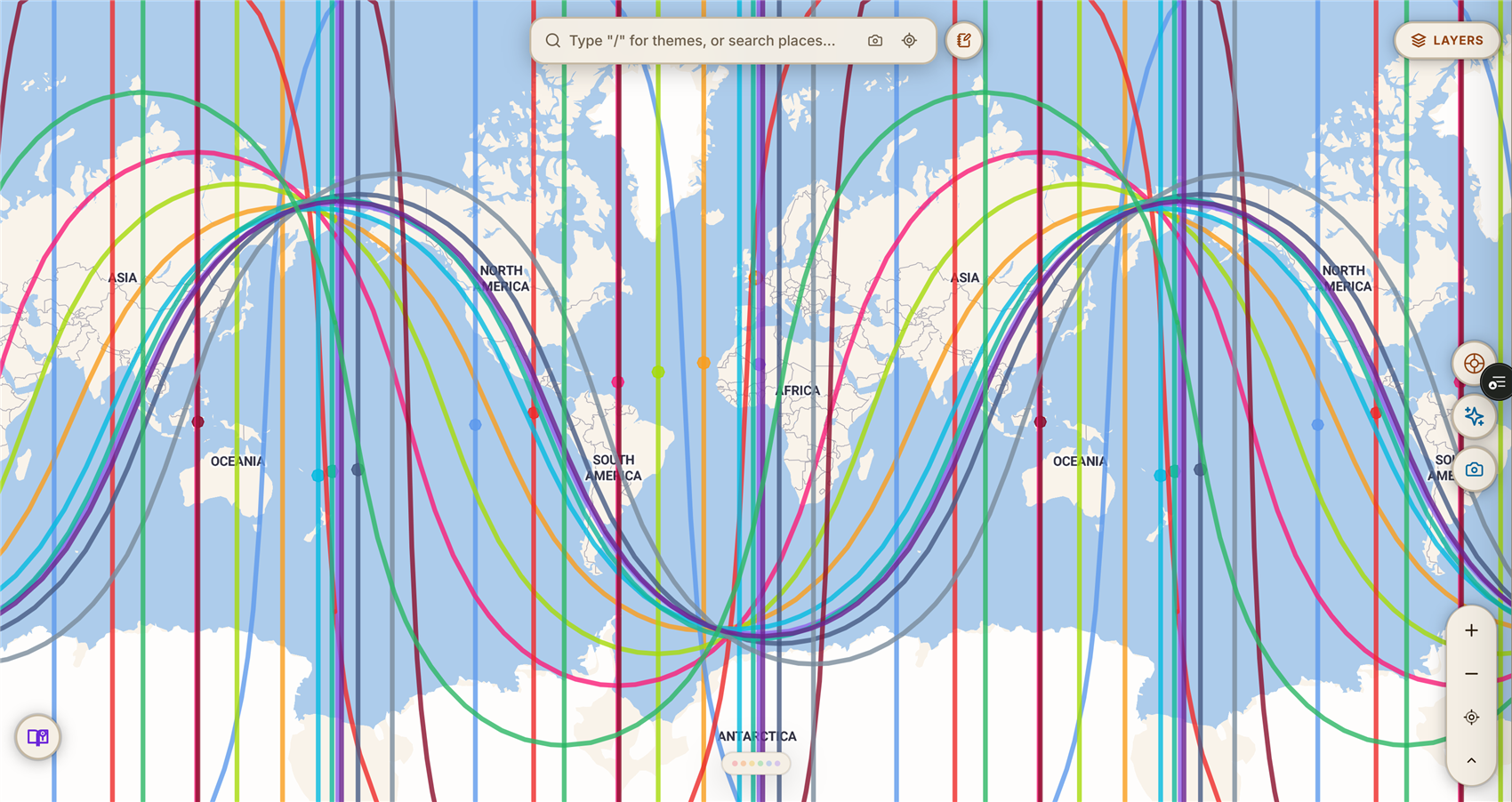
One birth chart, every planet's four lines, computed against the entire surface of the Earth at once. This is the whole-globe view the engine was built to produce. It's the thing a one-chart-at-a-time library can't do.
What "Personalized Geographic Intelligence" actually means
Precise astronomy is half of it. The other half is the writing. Here we made a deliberate choice that runs against the current.
Every interpretation in ELA Map comes from named, written astrological doctrine: a defined body of rules and meanings, authored deliberately and applied consistently. Ask the same question twice and you get the same answer, because the answer is derived, not improvised. You can disagree with the doctrine. People have argued about astrology for three thousand years and will keep arguing. But you can always see exactly which tradition produced the sentence in front of you. Nothing is made up on the spot to sound profound.
Two places go one step further. The readings on your Today page and your Location Reports are compiled from our interpretation library, refined by AI. Every fact in them comes from your chart's computed positions and lines, and a Today reading that names a line, planet, gate or house that isn't in your chart is thrown out before you see it.
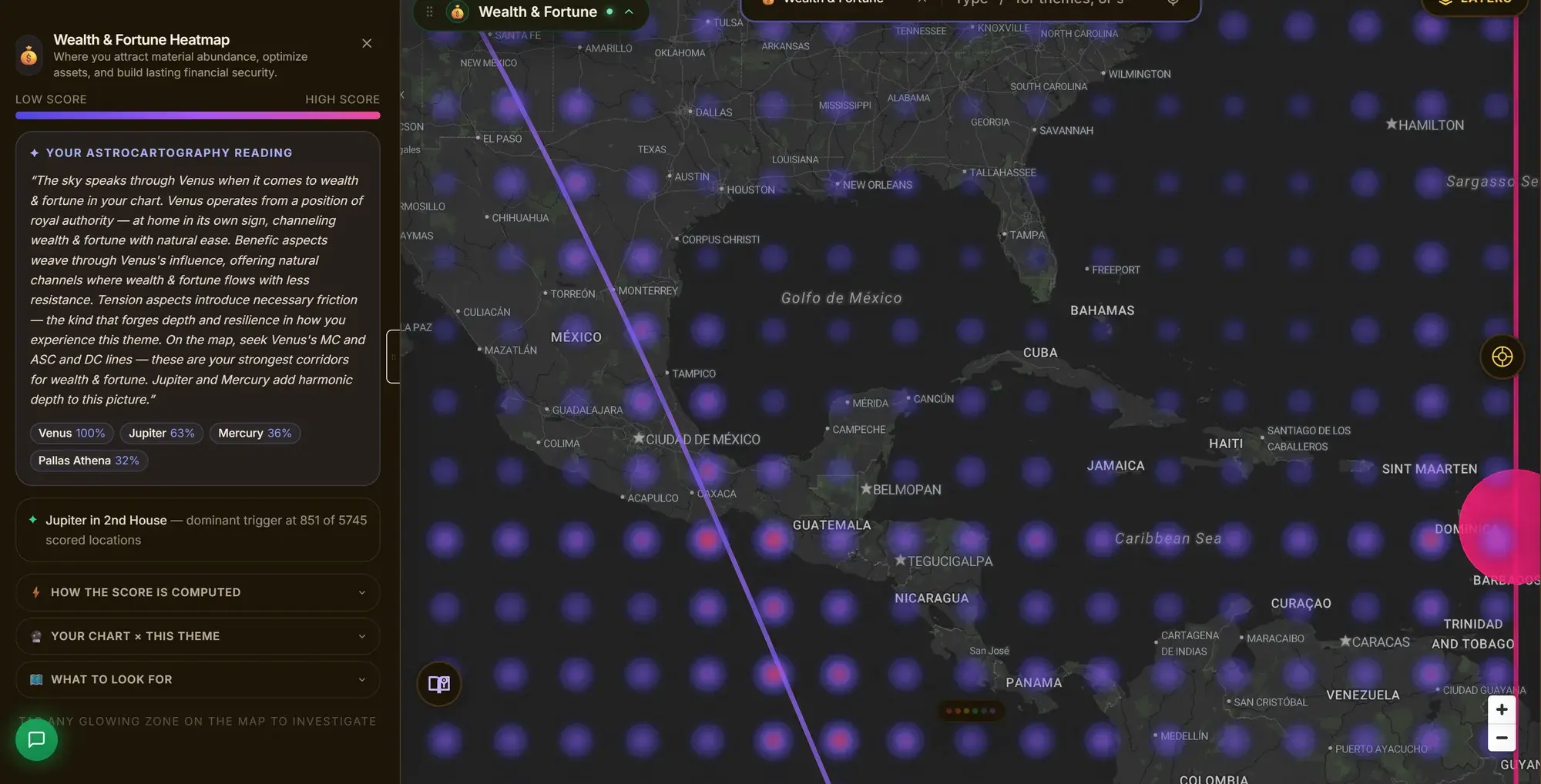
That is the exact opposite of pointing a language model at your chart and printing whatever it comes up with. Personalized Geographic Intelligence joins the two halves: NASA-grade positions underneath, transparent human doctrine on top, personalized to your chart and the specific place you're asking about. It's accurate, location-aware, yours to trust, and able to show its work.
How we keep ourselves honest
A few disciplines, stated plainly, because "trust us" isn't an argument:
- Determinism. The same birth data produces the same chart, every run, on every machine. No randomness, no drift, nothing that changes between page loads.
- The hourly NASA check. Described above: continuous validation against JPL Horizons.
- Reference charts. The Human Design and astrology engines are tested against independently published reference charts. A regression that moved a gate or an angle gets caught before release.
- Transparent doctrine. Every interpretation on the map is traceable to a named source rather than a generated guess.
None of this makes astrology a science. It makes ELA Map honest software: the numbers are real and checked, the logic is fixed and inspectable, and we don't pretend a machine's improvisation is insight.
What it unlocks
- Astrocartography Fundamentals: the four-angle mechanics this engine computes across the globe.
- Human Design Astrocartography: the same precision, applied to your HD gates and channels.
- Family Astrocartography: reading one place against a whole household.
- The Heatmap Engine: how ELA Map scores a whole region at once instead of one line at a time.
- Is Your Astrocartography App Accurate?: the checklist for vetting any locational astrology tool, including this one.
- Glossary: plain-language definitions for ephemeris, ecliptic, paran, and the rest.
Put the engine on your chart
Free. No card. Run your own placements through it and check the math. About two minutes.
Get started